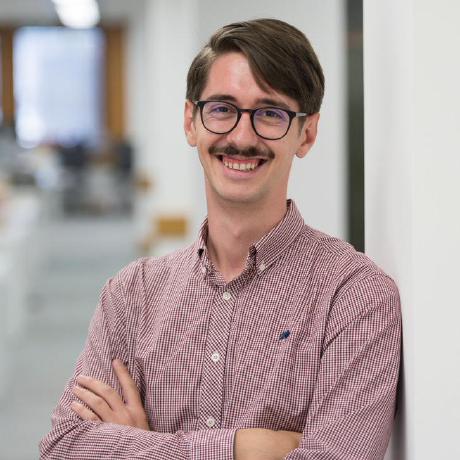
Victor-Alexandru Darvariu
I am a computer scientist working as a Postdoctoral Researcher at the Oxford Robotics Institute, University of Oxford, where I am a part of the GOALS group led by Nick Hawes. I am also a Retained Lecturer in Engineering Science at Jesus College and an Honorary Research Fellow at UCL Computer Science. From November 2026, I will join the University of Sheffield as a Lecturer (Assistant Professor).
I am interested in reinforcement learning (RL) and artificial intelligence (AI) more broadly. The key insight behind my work is the ability of RL to discover, by trial-and-error, ways of solving decision-making problems that can outperform or complement traditional methods. My work develops rigorous RL methodologies, especially for graph-structured systems (Graph RL), and applies them to disciplines as diverse as robotics, operations research, and statistics (AI for Science).
News
[Sep 2026] In our latest work, we propose the Graph Dynamics Model (GDM), a world model designed for graph environments with stochastic dynamics and evolving topologies. We also propose the Graph Distribution Distance (GDD) metric, which addresses the thorny evaluation challenge in this setting. Check it out here.
[Sep 2026] Our work on FlowIQN will be presented at NeurIPS 2026. FlowIQN is a theoretically grounded flow-matching critic for distributional RL. By aligning flow matching with optimal transport and Wasserstein geometry, we bridge recent ideas in generative models with the foundations of distributional RL. This improves the accuracy of the return distribution and, in some cases, downstream offline RL performance.
[Aug 2026] Our paper on GNARL, which reimagines the learning of algorithm trajectories as a Markov decision process, has now been published in Transactions on Machine Learning Research (TMLR). GNARL is a very versatile method that applies to both polytime solvable and NP-hard algorithmic problems. We also released accompanying code.
[Jul 2026] Thrilled to be be joining the School of Electrical and Electronic Engineering at the University of Sheffield as a Lecturer in Machine Learning for Engineering from November 2026. I'll be recruiting a PhD student (fully funded, UK home fees) to start in February 2027 as I set up my research group on graph reinforcement learning and AI for science & engineering. Feel free to get in touch for an informal chat.
For older news, see the archive.